
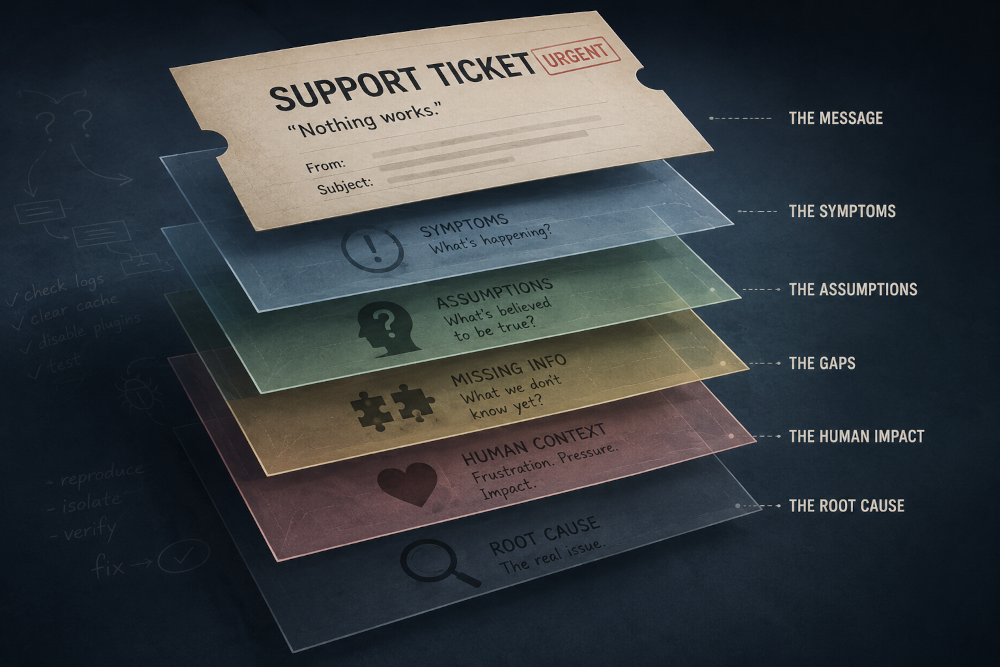
Most people think a difficult support ticket is one with a complicated technical problem.
After fifteen years in WordPress support, I’ve come to believe that the hardest tickets usually have very little to do with technology.
Technology is only the stage. The real story is about uncertainty.
A customer writes in after spending an entire afternoon trying to fix their website. They’ve disabled plugins, switched themes, cleared caches, searched forums, watched YouTube videos, and copied snippets from blog posts they barely understood.
Nothing worked.
By the time the ticket reaches support, they’re no longer asking for technical help. They’re asking for certainty.
That changes everything.
What Customers Actually Report (Hint: Not the Problem)
The first lesson every experienced support engineer learns is that customers don’t report problems. They report symptoms. And symptoms can be misleading.
“The homepage is broken.” “My header disappeared.” “The update ruined my site.” “My checkout page doesn’t work.”
These are observations from the customer’s point of view. Sometimes accurate, sometimes an educated guess, sometimes completely wrong.
I once received a ticket saying our theme update had broken an entire WooCommerce store. It sounded serious. After reproducing the environment, checking recent commits, and comparing versions, nothing looked suspicious.
Eventually, I asked one question: “When did this first happen?”
“It started before I updated.”
The update wasn’t the cause. It was just the last thing the customer remembered doing. That’s human nature. Our brains connect events even when they aren’t related.
Good support engineers learn to separate chronology from causality. They’re not the same thing, and confusing them wastes everyone’s time.
The Assumptions Nobody Notices
Every ticket contains assumptions. Customers have them. Support engineers have them. Developers have them. The dangerous ones are the assumptions nobody notices they’re making.
A beginner reads a ticket mentioning a page builder and immediately assumes the page builder is responsible. An experienced engineer asks a different question.
“What evidence actually supports that conclusion?”
That small shift changes the entire investigation. Debugging isn’t about proving your first idea. It’s about trying to disprove it. The more theories you eliminate, the closer you get to the truth.
I’ve learned to become suspicious whenever a problem seems obvious. The obvious answer has fooled me more times than I care to admit.
The Detail That’s Always Missing
Some tickets arrive with twenty screenshots. Others arrive with a single sentence. Ironically, both can be equally difficult.
Screenshots show what someone decided to capture. Logs reveal what actually happened. A long explanation can still leave out the one detail that matters most.
What version of WordPress are they running? Can the issue be reproduced on a clean install? Does it only happen for logged-in users? Is caching involved?
I remember a ticket where a customer insisted their contact form had stopped working after a plugin update. We went back and forth for two days. The form was working fine. The issue was a hosting-level email configuration that had quietly changed around the same time. Nothing to do with the plugin. Nothing to do with WordPress at all.
Sometimes solving a ticket isn’t about discovering new information. It’s about discovering what information is missing.
Support often feels less like answering questions and more like asking better ones.
The Pressure Behind the Words
Technical problems create emotional pressure, and that pressure shapes every conversation in ways that aren’t always visible.
A freelancer worrying about losing a client doesn’t just need the bug fixed. They need to know someone understands what’s at stake. An agency under a deadline isn’t being dramatic when they mark something urgent. An online store owner watching their checkout page fail is watching money disappear in real time. A beginner who thinks they’ve destroyed months of work is genuinely scared.
I’ve learned to read for that subtext before I read for technical details.
One sentence can completely change a conversation. “I understand why this is stressful” isn’t filler. It tells the customer that someone is actually listening, not just processing their ticket. Empathy doesn’t replace technical skill. It makes technical skills more effective.
Customers who feel heard are more patient, more cooperative, and more honest about the details they might otherwise leave out. That makes the investigation faster. Everyone benefits.
Where the Real Work Begins
This is my favourite part. Not because it’s easy, but because it’s honest.
Every investigation begins by admitting something simple: I don’t know.
That’s not a weakness. It’s the starting point of every real discovery. Experienced support engineers rarely chase answers immediately. They collect evidence first. They try to reproduce the issue. They look at what changed and what didn’t. They isolate variables one at a time.
It feels surprisingly similar to detective work. Every clue earns its place. Every assumption gets questioned. And conclusions have to be earned, not assumed.
The Reported Problem and the Real Problem
These are often different things. Sometimes very different.
A broken layout turns out to be cached CSS. A plugin conflict turns out to be outdated PHP. A missing button turns out to be a browser extension nobody thought to mention. A slow website turns out to be an overloaded server that has nothing to do with the site itself.
The deeper I work in support, the less interested I become in fixing symptoms. Root causes are where the real learning happens.
Finding them requires patience. Sometimes a lot of it.
What Customers Actually Remember
Customers remember more than whether the issue was fixed.
They remember how they were treated during the process.
I’ve worked on tickets where the investigation took longer than anyone wanted, yet the customer left the conversation happier than if we’d solved it in five minutes. The difference wasn’t speed. It was communication. Keeping them informed. Letting them know we were genuinely working through the problem.
“I’ve ruled out these possibilities.” “I’m still investigating.” “Here’s what I’ve learned so far.”
Progress builds confidence. Silence creates anxiety. Communication isn’t just courtesy — it’s part of the solution.
What Difficult Tickets Leave Behind
Every hard ticket leaves something behind.
A strange plugin conflict you’ve never seen before. An obscure server configuration. A browser behaviour that shouldn’t be possible but somehow is. These things accumulate. Over time, they become more valuable than any knowledge base.
Experience doesn’t give you all the answers. What it gives you is a better sense of where to begin. That intuition — knowing which thread to pull first — is built from every confusing, frustrating, hard-to-close ticket you’ve ever worked through.
That’s what keeps support interesting. The problems keep changing. The curiosity doesn’t.
The Habit of Thinking This Way
I’ve noticed over the years that the mindset you build through support doesn’t stay neatly inside the work.
Life presents symptoms, too. Arguments that seem to be about one thing but are really about something else. Failures that feel sudden but have been building quietly for a long time. Decisions that seem obvious until you stop and ask what evidence you’re actually working with.
The same questions apply. What assumptions am I making? What information is still missing? What’s the real problem underneath the reported one?
They’re debugging questions. They’re also just good questions.
What Support Engineering Is Actually About
People often think support engineering is about fixing software.
I think it’s about understanding systems. Some systems are technical. Some are human. The best support engineers learn to navigate both and to know which one they’re actually dealing with at any given moment.
Every difficult ticket is an invitation to slow down, stay curious, and resist the first explanation that seems to fit.
The bug eventually gets fixed. The ticket eventually gets closed. But if you’ve approached it with patience and genuine curiosity, you’ve gained something that outlasts the resolution.
You’ve practiced thinking clearly under pressure.
That’s worth more than a resolved case. It’s worth more than any certification or course. And unlike a closed ticket, it stays with you.