
Most support tickets don’t begin as technical problems.
They begin as human problems.
Someone is frustrated. They’ve already spent hours trying to fix something. Deadlines are slipping. A client is waiting. Their website is down, or worse, it’s behaving unpredictably.
By the time they write to support, the technical issue is only half the story. The emotional context is the other half.
After handling thousands of support conversations over the years, I’ve noticed something interesting.
The tickets people remember are rarely the simple ones. They’re the difficult ones. The impossible bug.
The customer who says they’ve “tried everything.”
The issue that refuses to reproduce.
The ticket with twenty screenshots, fifteen plugins, and a one-line description:
“Nothing works.”
Those are the tickets that teach you the most.
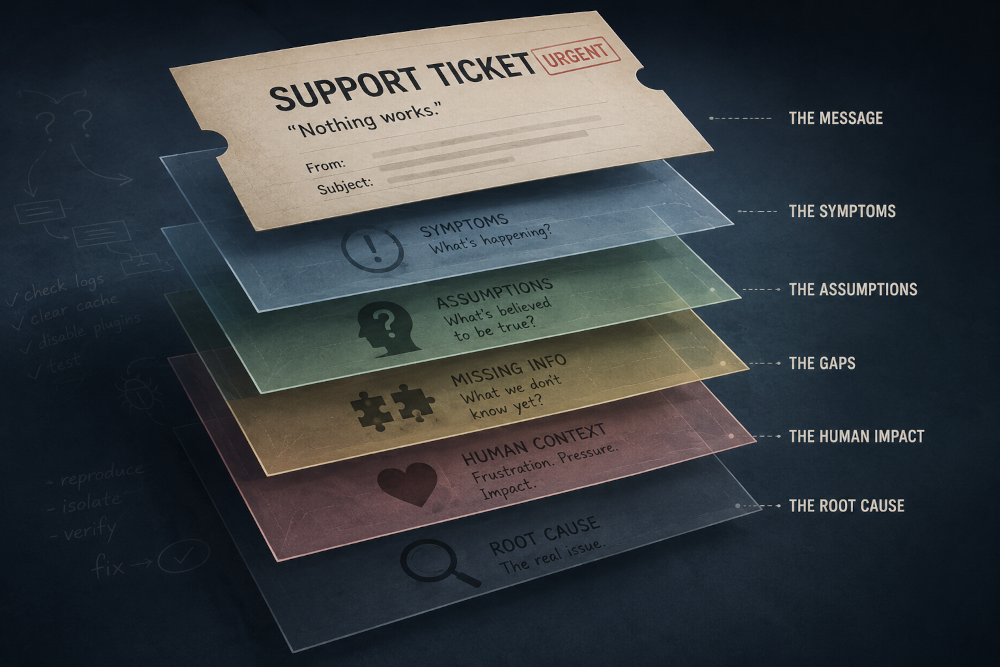
Every Difficult Ticket Has Layers
At first glance, a support request usually presents a symptom.
“The header disappeared.”
“The checkout page is broken.”
“My site is slow.”
But symptoms are only the surface. Beneath them are assumptions.
Maybe the customer assumes yesterday’s update caused the problem.
Maybe they believe the theme is responsible because disabling it changes the behavior. Sometimes those assumptions are correct. Often they aren’t.
A good troubleshooter learns to separate symptoms from causes.
That’s where real debugging begins.
The Missing Information Is Usually the Most Important
One of the biggest mistakes new support engineers make is focusing only on what the customer tells them.
Experienced engineers pay equal attention to what wasn’t said.
What version are they using?
Did the problem exist before today?
Is this happening on every browser?
Can the issue be reproduced on a clean installation?
Sometimes the answer isn’t hidden inside the ticket. It’s hidden inside the questions that haven’t been asked yet.
Support is often less about knowing answers than knowing which questions unlock them.
Complexity Doesn’t Always Mean Difficulty
Some of the most technically complex issues turn out to have simple explanations.
A forgotten cache.
A browser extension.
A typo buried inside custom CSS.
Meanwhile, a problem that looks trivial can consume an entire afternoon because multiple small issues combine into one confusing symptom.
That’s why experienced support engineers resist making quick assumptions.
The first explanation isn’t always the correct one. And the most obvious answer often isn’t the real answer.
Customers Read Confidence
Here’s something I wish more technical people understood.
Customers don’t expect perfection. They expect progress.
When support goes silent, people assume nobody knows what’s happening. A simple message can completely change that.
“I’ve narrowed it down.”
“I’m testing another possibility.”
“I haven’t found the cause yet, but here’s what I’ve ruled out.”
Those updates don’t solve the bug. They solve uncertainty.
And uncertainty is often what creates frustration.
Difficult Tickets Test More Than Technical Skills
Technical knowledge matters.
Documentation matters.
Experience matters.
But difficult tickets reveal something deeper.
Patience.
Curiosity.
Humility.
You have to be willing to admit your first theory was wrong.
You have to keep asking questions when nothing makes sense.
You have to stay calm when the customer isn’t.
Some of the best support engineers I’ve worked with weren’t necessarily the fastest debuggers. They were simply the ones who stayed curious longer than everyone else.
Every Ticket Leaves You Smarter
The bug gets fixed.
The customer moves on.
The ticket gets closed.
But if you’re paying attention, something stays with you. You remember an obscure conflict between two plugins.
A browser quirk.
A server configuration you’ve never seen before.
A strange edge case that suddenly explains another issue months later.
Support creates a library of experiences that no documentation can fully capture.
Each difficult ticket quietly expands that library.
Beyond Support
I’ve come to believe that debugging isn’t just a technical skill. It’s a way of thinking.
Life presents symptoms, too. Conflicts, Failures, Misunderstandings.
It’s tempting to fix the visible problem as quickly as possible. But lasting solutions usually begin by asking better questions.
What’s really happening here?
What assumptions am I making?
What information am I missing?
The habits that solve difficult support tickets often solve difficult conversations, difficult decisions, and difficult problems outside of technology as well.
That’s why I still enjoy support after all these years. Not because every ticket is enjoyable.
But every difficult ticket is an opportunity to think a little more clearly than I did yesterday.