
“When you have eliminated the impossible, whatever remains, however improbable, must be the truth.”
That famous Sherlock Holmes quote has lasted for more than a century because it describes more than detective work.
It describes problem solving.
It also describes the mindset behind effective debugging and troubleshooting.
After years in technical support, I’ve learned that the best troubleshooters don’t always know the most code. They ask the best questions. They notice what others overlook. They resist the urge to jump to conclusions.
In other words, they think like detectives.
Every Bug Is a Mystery in Problem Solving
Imagine a customer reports:
“Your plugin broke my website.”
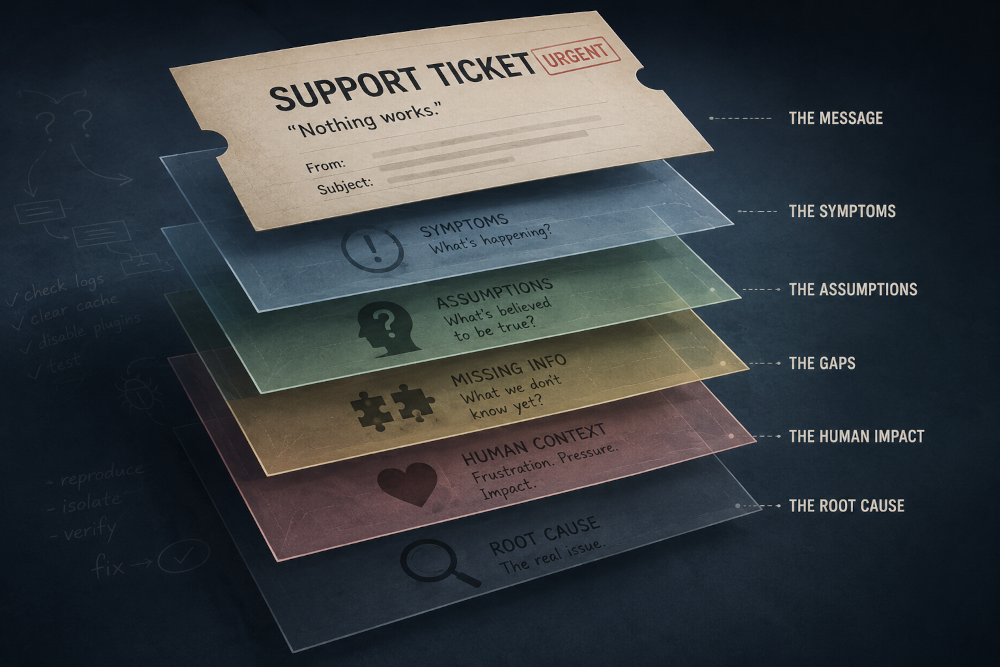
That’s not a diagnosis. It’s a witness statement.
Witnesses are not always wrong, but they are rarely complete.
Something happened. The user saw the result and naturally connected the dots in the most obvious way.
A detective knows better.
The first version of every story is only the beginning of the investigation.
In debugging and troubleshooting, the real challenge is not reacting to the symptom. It is uncovering the cause.
Separate Facts From Assumptions
Sherlock Holmes had an unusual habit: he collected facts before building theories.
Many of us do the opposite.
A support ticket arrives.
We recognize a familiar symptom.
Our brain instantly whispers:
“I’ve seen this before.”
Sometimes we’re right. Sometimes we’re confidently wrong.
Good debugging starts with listing only what we know.
The site crashes after activation.
PHP version is 8.2.
The issue appears only on one installation.
The error disappears when another plugin is disabled.
Everything else belongs in the “maybe” pile.
Facts first. Theories later.
That simple habit improves problem solving, speeds up troubleshooting, and prevents wasted effort.
Follow the Evidence, Not Your Ego
One of the hardest parts of debugging is admitting your first idea might be wrong.
We all become attached to our initial hypothesis.
We want to prove it.
A detective wants to disprove it.
That’s a subtle but powerful difference.
Every test should answer one simple question:
“If my theory is wrong, what evidence would prove it?”
When you approach troubleshooting this way, every failed experiment becomes progress. You aren’t losing. You’re narrowing the possibilities.
That is the heart of disciplined problem solving.
Small Clues Matter in Troubleshooting
Many bugs hide behind details that seem too insignificant to matter.
An extra space.
A single warning buried hundreds of lines above the fatal error.
One checkbox.
A browser extension.
A caching layer nobody remembered existed.
The smallest clue often unlocks the biggest mystery.
Experienced troubleshooters learn to slow down precisely when everyone else speeds up.
That patience is what separates reactive guessing from effective debugging.
Motive, Means, and Opportunity
Detectives ask who had the motive.
Debuggers ask what changed.
A bug rarely appears out of nowhere. Something changed.
A plugin update.
A server migration.
A PHP upgrade.
A new firewall.
A theme customization.
A DNS change.
An imported database.
Whenever someone says, “Nothing changed,” experience quietly replies, “Something almost certainly did.”
The challenge is finding it.
This is where systematic troubleshooting becomes essential. Instead of chasing symptoms, you trace the timeline and identify the trigger.
Eliminate Variables for Better Problem Solving
Holmes didn’t chase every suspect at once. He eliminated them one by one.
The same approach works beautifully in technical troubleshooting.
Disable one plugin.
Switch one theme.
Test one browser.
Change one setting.
Review one log.
Introduce one variable.
Remove one variable.
Repeat.
The goal isn’t to guess correctly but to reduce uncertainty. As you eliminate possibilities one by one, the list of potential causes becomes smaller until the answer is no longer hidden, but almost inevitable.
This is practical problem solving at its best: controlled, methodical, and evidence-driven.
Stay Curious
Curiosity beats intelligence more often than people think.
The smartest engineers still encounter bugs they’ve never seen.
What separates great troubleshooters is their willingness to keep asking:
“Why?”
What separates great troubleshooters is their willingness to keep asking, “Why?” Then they ask it again, and again, digging five layers deep until the surface symptoms fade away and the real root cause begins to emerge.
Curiosity keeps debugging from becoming routine guesswork. It turns troubleshooting into discovery.
Every Bug Teaches Something
The best detectives don’t just solve cases. They learn patterns, notice habits, and recognize behavior.
Debuggers do the same.
Every solved issue expands your intuition. You begin to recognize familiar footprints. Not because you’ve memorized every solution. Because you’ve learned how problems behave.
That’s a skill no documentation can fully teach.
Over time, strong problem solving becomes instinctive because you’ve trained yourself to observe, test, and learn from every debugging session.
Think Less Like a Programmer. More Like an Investigator.
The next time a difficult ticket lands in your inbox, resist the temptation to immediately search for the answer.
Instead, investigate.
Observe carefully.
Question assumptions.
Collect evidence.
Test patiently.
Let the facts guide you.
Because debugging isn’t about proving you’re right. It’s about discovering what’s true.
And that’s exactly how Sherlock Holmes would have approached problem solving, debugging, and troubleshooting.